
A rain poncho is a rain poncho. Right?
Well… not exactly.
One can be folded so small that it can stay in your bag by default. The other is large, colorful, and far too fun to wear only in bad weather. And someone who cycles every day needs completely different details.
That makes choosing sometimes harder than you think.
Because are you looking for a compact poncho for an unexpected shower? A model that fits loosely over your clothes? Or mainly a rain poncho with which you can cycle comfortably?
In this selection guide we show you what types there are and which rain poncho best suits how you want to use it.
Why choose a rain poncho?
The biggest advantage of a poncho is convenience. You quickly pull it over your clothes and don’t have to search for sleeves while the rain is already coming down.
Thanks to the loose fit, a rain poncho often also fits over a jacket, thick sweater, or part of your bag. Moreover, you have plenty of room to move and can usually easily store it again after use.
A rain poncho is useful for, among other things:
- cycling;
- during a walk;
- on holiday or a city trip;
- at a festival or outdoor event;
- as compact rain protection in your bag or car;
- when you want to quickly throw something over your regular clothes.
But not every poncho is equally suitable for all these moments. The model, size, and extra details make a big difference.
1. A small, foldable rain poncho for on the go
You don’t need a raincoat every day, but you do want to be prepared for an unexpected shower? Then a lightweight, foldable rain poncho is probably the best choice.
The Tretorn Light Rain Poncho is a great example. This model is designed to be easy to carry and quickly pull over your clothes as soon as it starts raining.
The Danefæ Danepackit also belongs in this category. It folds up into its own front pocket into a compact package of approximately 21 × 24 cm. The Danepackit is back in stock and thanks to its lightweight design and recognizable Danefæ print, it will soon be a great choice again for your handbag, backpack, bike bag, or suitcase.
The AGU Grant also deserves a place here. You can store this lightweight poncho of approximately 330 grams in the integrated front pocket; when packed, it measures approximately 27 × 21 × 3.5 cm. This makes it easy to carry, while the hand loops, waistbands, and adjustable hood also make it practical for cycling.
A foldable poncho is especially nice when carrying it is just as important as protection: you’ll have it with you as soon as the weather unexpectedly turns.

2. A large and stylish rain poncho that can be seen
Some ponchos you keep in your bag just in case. Others you wear precisely because they are far too fun to wear only in bad weather.
The loose-fitting rain ponchos from Danefæ clearly belong to the latter group.
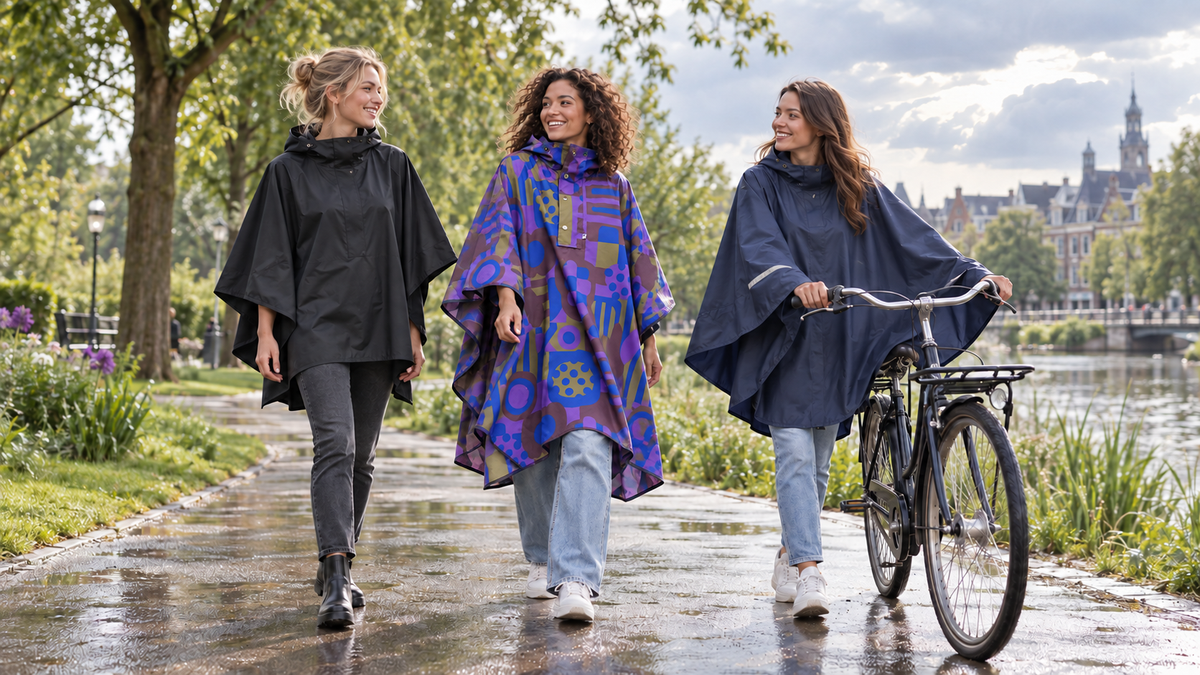
The Danedream Drops has a generous, oversized fit and striking prints. This makes it feel more like a real piece of clothing than something you only pull out for a sudden shower.
The Danefæ Danebodil also shows that a rain poncho doesn’t have to be anything but boring. The combination of plenty of room to move and bold designs makes these models great for walking, festivals, holidays, and ordinary rainy days.
Thanks to the loose fit, you can easily wear them over your everyday clothes. This is convenient when you don’t want to put on a traditional raincoat but still want to be well protected on the go.

3. A rain poncho especially for cycling
When cycling, you ask something different of a poncho than during a short walk.
You want enough room around your arms and legs, but the poncho should not constantly blow up. Visibility and a hood that stays in place well are also important.
The Happy Rainy Days Bikecape Reflectie is truly designed for cyclists. The waterproof and breathable fabric has a water column and breathability of 10,000, and the seams are taped. This gives you serious rain protection without the cape having to feel heavy or tight.
It is precisely the details that make the difference on the bike. On the inside, there are hand loops: you put your hands through them, so the front panel stays over the handlebars and your hands are also protected. A waistband at the back helps prevent it from blowing up and keeps the back in place better.
You can store the loose, adjustable hood in the collar. The Bikecape also has a large closable front pocket and a reflective strip for extra visibility during dark, gray rainy days. You can choose a calm color or a cheerful print.
The AGU Grant rain poncho is also a practical choice for cyclists. The hand loops keep your hands under the cape and the front panel over the handlebars, while waistbands and snap buttons help to limit blowing up. The adjustable hood also gives you room to look back properly, and the reflective detail helps you stand out better.
And then there is the AGU SEQ: a raincoat that transforms into a bike poncho while cycling. That clever combination deserves its own number, so more on that later.

4. A lightweight cape for a shorter shower
You can easily wear the lightweight capes from Rainraps over your clothes, and many versions can be worn on both sides. They are especially useful when you want to quickly throw on something stylish during a shorter shower.
For prolonged or heavy rain – and for daily cycling – you would rather choose a fully technical rain poncho or raincoat.

5. A jacket and bike poncho in one
Don’t want to choose between a regular raincoat and extra room on the bike? Then the AGU SEQ is a special intermediate solution.
You wear it as a stylish, longer raincoat for everyday use. When you get on the bike, you create extra room so the jacket gives more protection over your legs.
This makes this model interesting for someone who cycles every day but doesn’t want to walk around all day in a loose bike poncho. After your bike ride, you simply wear it as a jacket again.
Exactly the kind of design where you cannot immediately see from the outside how much practical technology is in it.

Poncho or raincoat: which is nicer?
A rain poncho is not automatically better than a raincoat – and vice versa. It depends on what you find comfortable and what you use it for.
You quickly pull on a poncho, it gives plenty of room to move, and easily fits over other clothes. A raincoat usually fits better around your body and arms and is often more comfortable in strong wind.
For everyday use, many people prefer a stylish raincoat. For cycling, a festival, holiday, or as a compact solution in your bag, a poncho can be ideal.
And some models, such as the AGU SEQ, combine the properties of both.
What to pay attention to when choosing a rain poncho?
What are you going to use it for?
A compact poncho for a city trip does not need to have the same properties as a model you cycle to work with every day. Therefore, always start with the moment of use.
How big and spacious is the poncho?
Do you want to wear it over a winter jacket or backpack? Then check if the model offers enough room for that. Oversized is comfortable, but a very loose poncho can also move more in strong wind.
Can the poncho be stored small?
If you mainly take it with you for unexpected showers, weight and foldability are important. You will ultimately take a compact poncho that actually fits in your bag more often.
Is it suitable for cycling?
Not every large poncho is automatically a good bike poncho. Pay attention to room to move, the way the front panel falls, the hood, and any details that help to keep the cape in place while cycling.
How does the hood fit?
A hood must protect your head without unnecessarily restricting your vision. Adjustability is especially pleasant in the wind and while cycling.
Do you want to be extra visible?
Do you often cycle in the dark or in bad weather? Then reflective details or a striking color can be a practical addition.
Can a rain poncho fit over a winter jacket?
Many loose models can easily fit over one. Oversized ponchos and bike capes in particular often offer enough room for a thicker jacket.
Do check the dimensions and fit of the chosen model. A compact or more fitted cape may fall less comfortably over a thick winter jacket.
Doesn’t a rain poncho blow up?
A loose poncho catches more wind than a fitted raincoat. How much trouble you have with that depends on the design, the fit, and the circumstances.
Special bike ponchos often have practical details that make them better suited for use on the bike. In strong wind, a well-fitting raincoat may still be the more comfortable choice.
Which rain poncho suits you? Quick selection guide
- Small to carry: Tretorn Light Rain Poncho or Danefæ Danepackit.
- Large, cheerful and striking: Danefæ Danedream Drops or Danebodil.
- Especially for daily cycling: Happy Rainy Days Bikecape Reflectie.
- Light and practical on the bike: AGU Grant.
- Raincoat and bike poncho in one: AGU SEQ.
- Stylish wrap cape: Rainraps.
Not just any poncho for any shower
The best rain poncho is not simply the largest or smallest model. It is the poncho that suits your day.
Do you mainly want to keep something small at hand? Then choose a lightweight, foldable version. Do you want to cycle to work dry? Then look at a real bike poncho or clever jacket/poncho combination. And should your rain outfit be seen? Then there are plenty of stylish capes and cheerful prints.
This way, a rain poncho does not become an emergency solution that stays at the bottom of your bag, but something you really enjoy as soon as the first drops fall.


Share:
It’s only drizzling a little… so why are you soaking wet?
What does a 70% chance of rain actually mean?